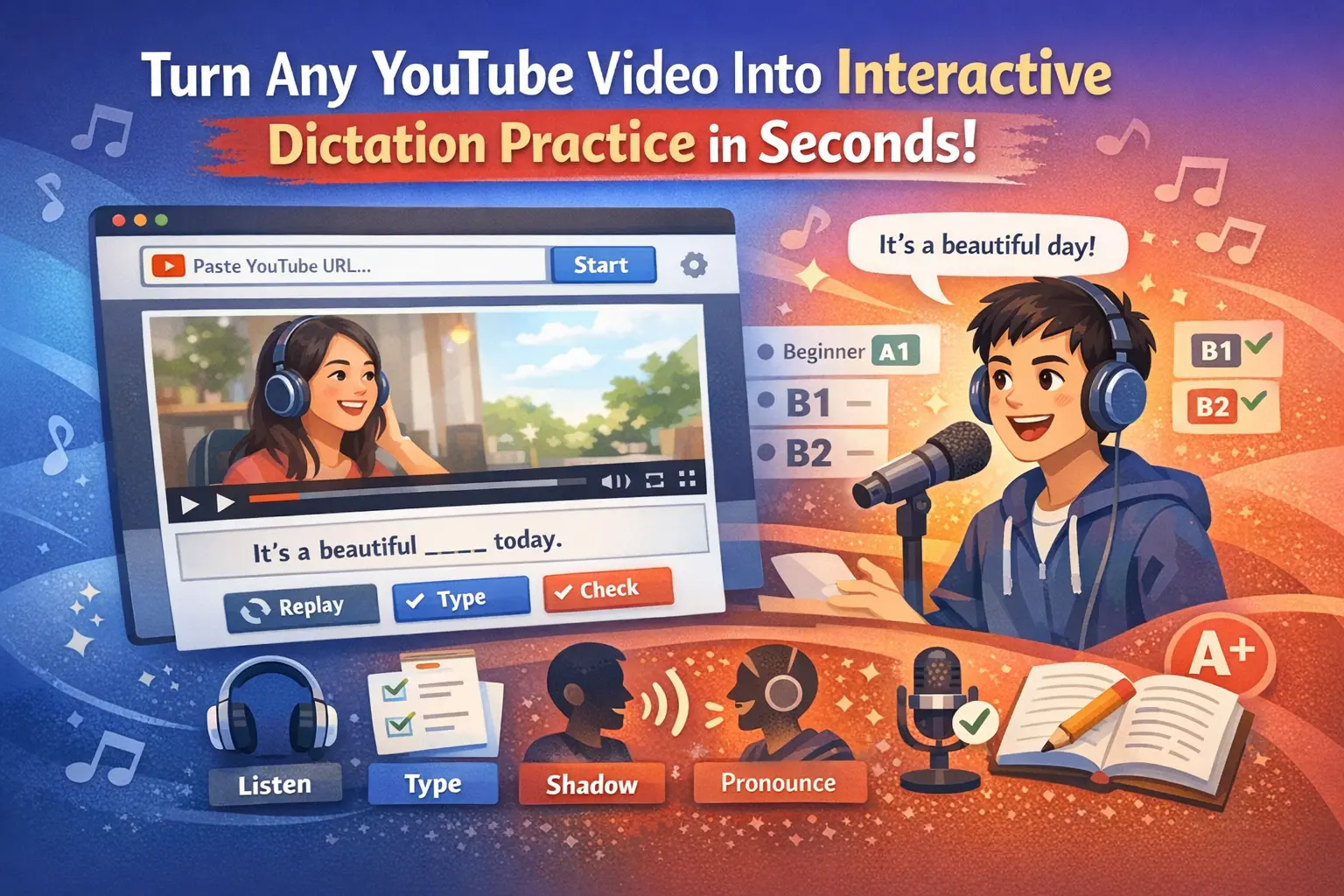
Paste a YouTube Link and Start: Chunk Dictation Practice for Faster English Listening Progress (A1–B2)
Most English listening practice fails for one reason: it’s too passive. You “listen to the English,” maybe read subtitles, maybe repeat a few lines, but you don’t train the core skill that makes real-life listening hard—decoding natural speech accurately.
A better approach is dictation practice done in short, repeatable chunks. Cambridge’s listening tips also encourage regular listening practice and practicing in chunks, which aligns perfectly with a modern, interactive workflow. Reference: https://www.cambridgeenglish.org/images/562911-tips-for-listening.pdf
This article shows you a practical system you can use for:
- listening for beginners (A1/A2)
- listening B1 and listening B2
- exam-style goals like Cambridge listening B1/B2, FCE listening practice, PET listening test, KET exercises listening, and other listening comprehension exercises
And importantly, it shows how FluentDictation makes the method frictionless:
Simply paste a URL, press start, and the video transforms into interactive YouTube dictation exercises. You can practice with any YouTube video—not just pre-made courses—so your daily listening becomes unlimited, personalized, and real.
Why “Full Transcript Dictation” Is Slow (and Chunk Dictation Works)
Traditional dictation often looks like this:
- play a long section
- miss details
- rewind endlessly
- lose your place
- spend more time controlling the player than training your ears
Chunk dictation flips that. You work in clear, short YouTube audio segments (a sentence or 10–20 seconds), and you repeat strategically until you can decode it reliably.
This is the missing bridge between “I understand written English” and “I can understand spoken English in real time.”
The FluentDictation Workflow: 6 Steps That Turn Any YouTube Video into Training
FluentDictation’s homepage describes a simple loop that matches how effective listening training should work. Here’s how to use it as a daily system.
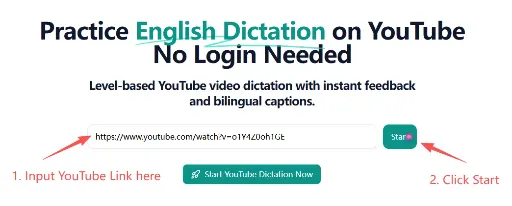
01) Choose YouTube Video: Paste the video link or pick from ours
Start with the easiest entry point:
- Paste or select a video
- Audio and captions auto-ready
- Practice with real speech—your favorite creators, interviews, podcasts, lessons
This matters because consistency dies when learners waste time finding materials, downloading audio, or hunting for transcripts.
Tip by level
- A1/A2: slow, clear dialogues (listening exercises A1/A2, listening worksheets with audio style content)
- B1: everyday topics, short explanations (listening practice B1, B1 listening test difficulty)
- B2: faster, more idioms, fewer pauses (listening exercises B2, listening test B2 level)
02) Listen to real speech: Rhythm, tone, and accents (the real challenge)
Real listening difficulty is not vocabulary—it's real speech:
- reductions (going to → gonna)
- linking (next_to → nex-to)
- weak forms (to /tə/, of /əv/)
- accents and speed variation
That’s why the practice should be based on real audio, not overly clean studio recordings only.
FluentDictation encourages you to:
- Listen to clear, short YouTube audio
- Catch natural rhythm and tone
- Build “listening in English language” skill that transfers to real life
Your rule: One chunk should feel “challenging but solvable.” If you catch almost nothing, drop the difficulty or shorten the chunk.
03) Type your answer: Dictation forces accuracy (not “vibes”)
This is where listening improves fast:
- Type what you hear for accuracy
- Type each word
- Watch for details
Typing creates a measurable outcome. It stops the illusion of “I understood” when you only understood the general topic.
This is true for:
- listening comprehension practice
- comprehension listening exercises
- English listening test preparation (Cambridge / IELTS / TOEIC / TOEFL patterns)
Practical rule: don’t guess missing words. Use blanks like ____. Guessing trains the wrong sound-to-word mapping.
04) Check & correct: Compare to transcript and fix mistakes immediately
Dictation without correction is just copying sounds. The learning happens in the “check” step:
- Compare to transcript
- Find skipped parts
- Fix errors immediately
This is exactly what most learners skip, and it’s why their listening English doesn’t improve even after hours of exposure.
Make review systematic (30 seconds per chunk): Label each mistake as one of these:
- Word boundary (you cut the words in the wrong place)
- Weak forms (you didn’t hear “to/of/a/the”)
- Grammar endings (-s / -ed)
- Sound confusion (ship/sheep, can’t/can)
- Unknown word (you didn’t know it at all)
Then write one “repair note,” e.g.
“I missed ‘to’ because it was reduced /tə/ before a consonant.”
That single note is what upgrades your ear.
05) Shadowing Aloud: Speak along to improve fluency
Dictation improves decoding. Shadowing improves speaking flow.
FluentDictation’s loop makes it natural:
- Read with the model audio
- Speak smoothly, practice delivery
- Train rhythm, stress, and intonation
If you only do dictation, you’ll hear better but may still struggle to speak. Shadowing links listening to output: listen and speak English becomes one skill chain instead of two separate tasks.
Beginner-friendly shadowing option: Start with “listen and repeat English” (slight delay), then build up to near-simultaneous shadowing.
06) Pronunciation Assessment: Instant feedback on your speaking
Shadowing is powerful, but many learners don’t know if they’re improving. Pronunciation assessment adds a feedback loop:
- View scores for fluency and accuracy
- See highlights, retry anytime
- Iterate until you hit a stable score improvement
This makes your training measurable—especially for learners aiming for B1 listening exam / listening exam B2 outcomes where clarity and fluency matter.
The Chunk + Replay Method (Exact Rules That Work)
Cambridge suggests practicing listening regularly and in manageable parts. Here’s the concrete version you can apply today.
Chunk size by level
- A1 / A2: 6–10 seconds
- B1: 10–20 seconds or 1 sentence
- B2: 15–30 seconds or 1–2 sentences (but only if solvable)
Replay rules
For each chunk:
- First listen: no typing
- Second–fourth listens: type what you hear
- Fifth listen: check and correct
- Final listen: replay with correct text to “lock in” sound-to-text mapping
This turns random listening into structured listening comprehension exercises.
A 20-Minute Daily Plan You Can Repeat (Beginner → B2)
For beginners (A1/A2): listening practice for beginners
- 2 min: pick a short clip
- 12 min: 3 chunks × (listen → type → check)
- 4 min: replay each chunk once with corrected text
- 2 min: repeat aloud
Good for listening beginner exercises, listening exercises for beginners, English listening for beginners.
For B1: listening practice B1
- 2 min: first listen and predict meaning
- 12 min: chunk dictation (3–4 chunks)
- 4 min: error labeling + repair notes
- 2 min: shadowing aloud
Supports listening exercises B1, B1 listening test readiness.
For B2: English listening B2
- 2 min: first listen + one-sentence summary
- 12 min: chunk dictation with stricter replay limits
- 4 min: fix endings/weak forms systematically
- 2 min: shadowing + pronunciation assessment
Supports listening exercises B2, Cambridge listening B2 performance habits.
Exam Use: Cambridge / IELTS / TOEIC / TOEFL Without Endless Tests
Many learners search:
- cambridge listening practice test
- cambridge listening test
- fce listening practice
- pet listening test, ket practice
- ielts cambridge listening test
- listening for the toeic test
- toefl listening script
Here’s the key: tests show your level; chunk dictation builds the skill.
Use exam audio as your material, but train it with:
- chunk → type → check → replay → shadowing
That’s how you turn “test practice” into improvement.
Why This Works Better Than Passive Apps (and Even Better Than Random Exercises)
Some learners do duolingo listening exercises or generic ESL listening exercises every day and still plateau. Common reasons:
- the content is too short or too repetitive
- there’s no correction loop deep enough to fix decoding errors
- it doesn’t train real speech rhythm and accents
The FluentDictation approach solves this by combining:
- real YouTube speech
- interactive dictation (type, check, correct)
- speaking practice (shadowing)
- measurable pronunciation feedback
In one loop.
Start Today: Your “Paste URL → Press Start” Challenge
Pick one YouTube video you genuinely enjoy.
- Paste the video link
- Press start
- Do 3 chunks only
- Type, check, correct
- Shadow the corrected lines once
- (Optional) Run pronunciation assessment and retry your weakest line
That’s it. Repeat daily.
If you can do this 5 days a week, your English listening skills will improve faster than “just watching more videos,” because you’re not consuming—you’re training.
Reference
- Cambridge English Listening Tips (regular practice + practising in chunks): https://www.cambridgeenglish.org/images/562911-tips-for-listening.pdf
Author